What moving actually costs — the number most people do not
run
When families decide they have outgrown their Toronto
home, the instinct is to look at what larger homes are selling
for and subtract what their current home might fetch. That
calculation misses most of the actual cost.
The full cost of moving in Toronto
Real estate commission on the sale: 4% to 5% of sale
price. On a $1.2 million East York home, that is $48,000 to
$60,000.
Ontario Land Transfer Tax on the purchase:
On a $1.6 million home, approximately $28,000.
Toronto
Land Transfer Tax: On a $1.6 million home, approximately
$26,000.
Legal fees, title insurance, and moving: $8,000 to
$14,000.
Home inspection, bridge financing (if timing does
not align): $3,000 to $8,000.
Immediate repairs and updates
on the new property: $15,000 to $50,000 for most resale
homes.
Total transaction cost: $105,000 to $160,000 —
before you have bought a single square foot of additional space.
And that is assuming the larger home you buy is in a
neighbourhood you like as much as the one you are leaving.
The cost of a home addition varies by type and scope. Here is the
general range in the Toronto market:
Rear addition (200 to 400 sq
ft, main floor extension): no cost data published — get a
site-specific quote
Second floor addition (800 to 1,200 sq ft,
full upper storey): no cost data published — get a site-specific
quote
Side addition (100 to 200 sq ft, wider lots only): no cost
data published — get a site-specific quote
We do not publish specific cost ranges on this page because
they vary significantly based on your home, your lot, the complexity
of the structure, and the finish level you want. What we will say: a
properly scoped, fully permitted addition delivered by a professional
general contractor costs considerably less than the combined cost of
selling your current home and buying into a larger one.
The only way to get a number that is actually useful to your
decision is a site visit and a proper scope assessment. That is what
we offer, at no charge.
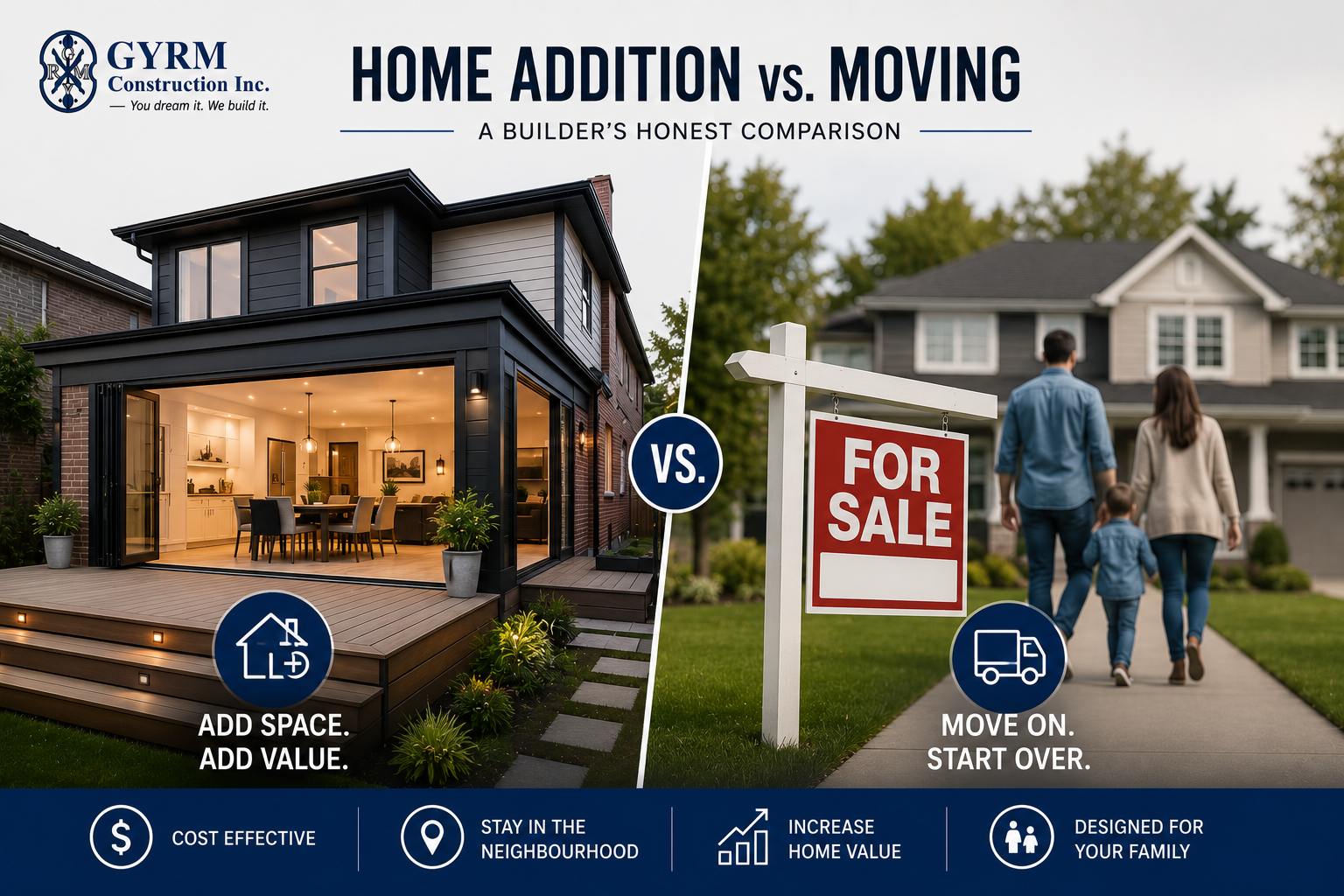
If the answer is yes and for most Toronto families in established neighbourhoods, it is the addition wins on this factor alone. Moving to get more space almost always means moving to a neighbourhood you know less well, often farther from the schools, transit, and community infrastructure you have built your life around.
A home addition builds on top of what exists. If the foundation has moved significantly, if there are structural problems that have been deferred, or if the home has been through undocumented renovations that left it in worse shape than it looks — a renovation or addition compounds those problems. A new build might be the better path.
Some floor plans cannot be improved through renovation. If you need a fundamentally different layout — not just more space, but a different configuration — that changes the calculus. A rear addition changes what is at the back of the house. A second floor addition adds an upper floor. Neither changes the fundamental structure of the main floor unless a renovation is paired with it.
Moving can be done in 60 to 90 days. A second floor addition takes 4 to 6 months from permit issuance — and the permit takes 6 to 10 weeks. If you need to be in a larger home immediately, moving is faster. If you can plan 9 to 12 months ahead, an addition is feasible.
In some Toronto neighbourhoods, a second floor addition brings your home's value above the neighbourhood's effective ceiling — the price at which comparable homes have difficulty selling. In those cases, the addition may cost more than it adds in resale value. In most established Toronto neighbourhoods — East York, Leaside, North York, The Beaches — the ceiling is high enough that a well-built addition adds real value.
We build additions for a living. We also believe in telling people what is actually right for their situation, even when the right answer is not a project for GYRM.
Your existing home has structural or foundation issues that
would cost more to address than the addition is worth.
You need a
fundamentally different neighbourhood — better schools, shorter
commute, different community — not just more space.
Your target neighbourhood is one where additions consistently
exceed the price ceiling.
You need the additional space within 90
days and cannot wait for a permit and construction timeline.
Your
home is already at the upper end of its street's value range and
a further addition would represent diminishing returns.